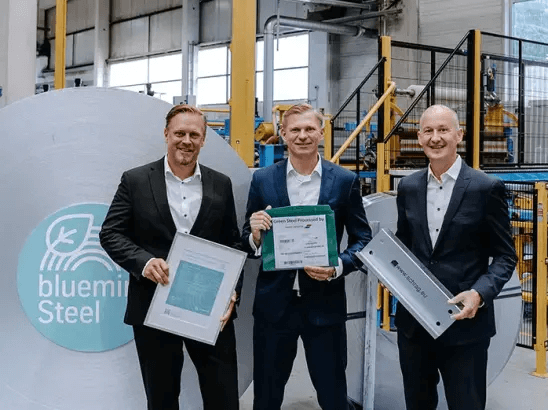
The portfolio of Knauf Interfer's steel service centres ranges from sheets and slit strip to coiled rings and is supplemented by special grades and intermediate thicknesses for the prototype sector. The extensive range of organically coated products for industrial applications, which will soon be supplemented by particularly sustainable solutions, is also characteristic. In May 2023, Knauf Interfer and thyssenkrupp Steel signed a Memorandum of Understanding (MoU) on the supply and purchase ofCO2-reduced steels.
Commitment to environmental protection
The MoU stipulates that, as a first step, the Knauf Interfer plants will be supplied from this year with steels that have a significantly lowerCO2 footprint thanks to the use of specially processed scrap. In the future, Knauf Interfer also intends to source materials from the bluemint® Steel product family from thyssenkrupp for its entire Steel business unit. These are produced in a direct reduction process using hydrogen and help to avoid climate-damaging emissions. "The significant reduction in thecarbon footprint of our primary products is an important milestone in the decarbonisation of the entire chain from production to the end consumer," says Domenico Marino, COO on the Executive Board of Knauf Interfer SE. Axel Pohl, Head of Sales Industry OEM & SSC at thyssenkrupp Steel, sees the alliance between the two companies as an important signal: "We are equally committed to sustainability and climate protection. The agreement is therefore not only a further joint step in our strategic partnership, but also proof that major challenges facing society as a whole can only be tackled together."
Ecological materials are becoming more important
Knauf Interfer and thyssenkrupp Steel are quickly following up their spring announcement with action. Driven by the idea of solving customer challenges together, both partners are working together to convince potential customers based on their expertise in materials and consulting. Also when it comes to sustainability. A philosophy that SCHRAG also pursues. Depending on the order and requirements profile, SCHRAG procures material directly from thyssenkrupp Steel or via steel service centres such as Knauf Interfer. At the steel service centre, the steels are temporarily stored and suitably finished before being sent to the individual SCHRAG production sites for further processing. And in future,CO2-reduced steels from the bluemint® Steel brand will also be included. "The ecological consideration of materials is becoming increasingly important in construction," says Thomas Goswin, Managing Partner of the SCHRAG Group. Sustainable materials are playing an increasingly important role, especially in tenders for administrative complexes or other public buildings. Goswin: "The construction industry is a price-sensitive sector and not every customer is yet prepared to pay a premium for climate-neutral steel. But the more influence politicians exert through legal requirements, the bigger the issue will become."
Looking to the future with foresight
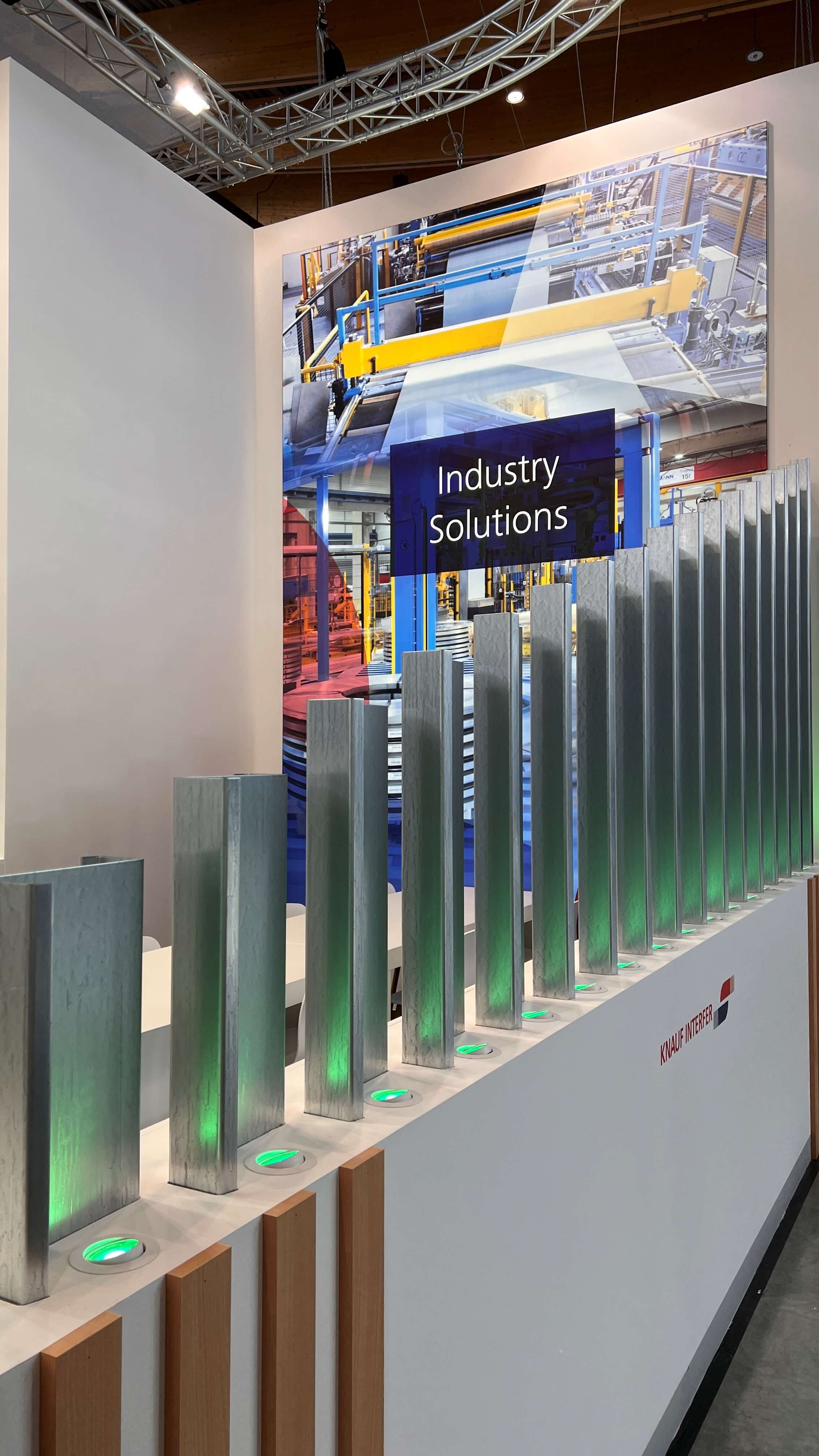
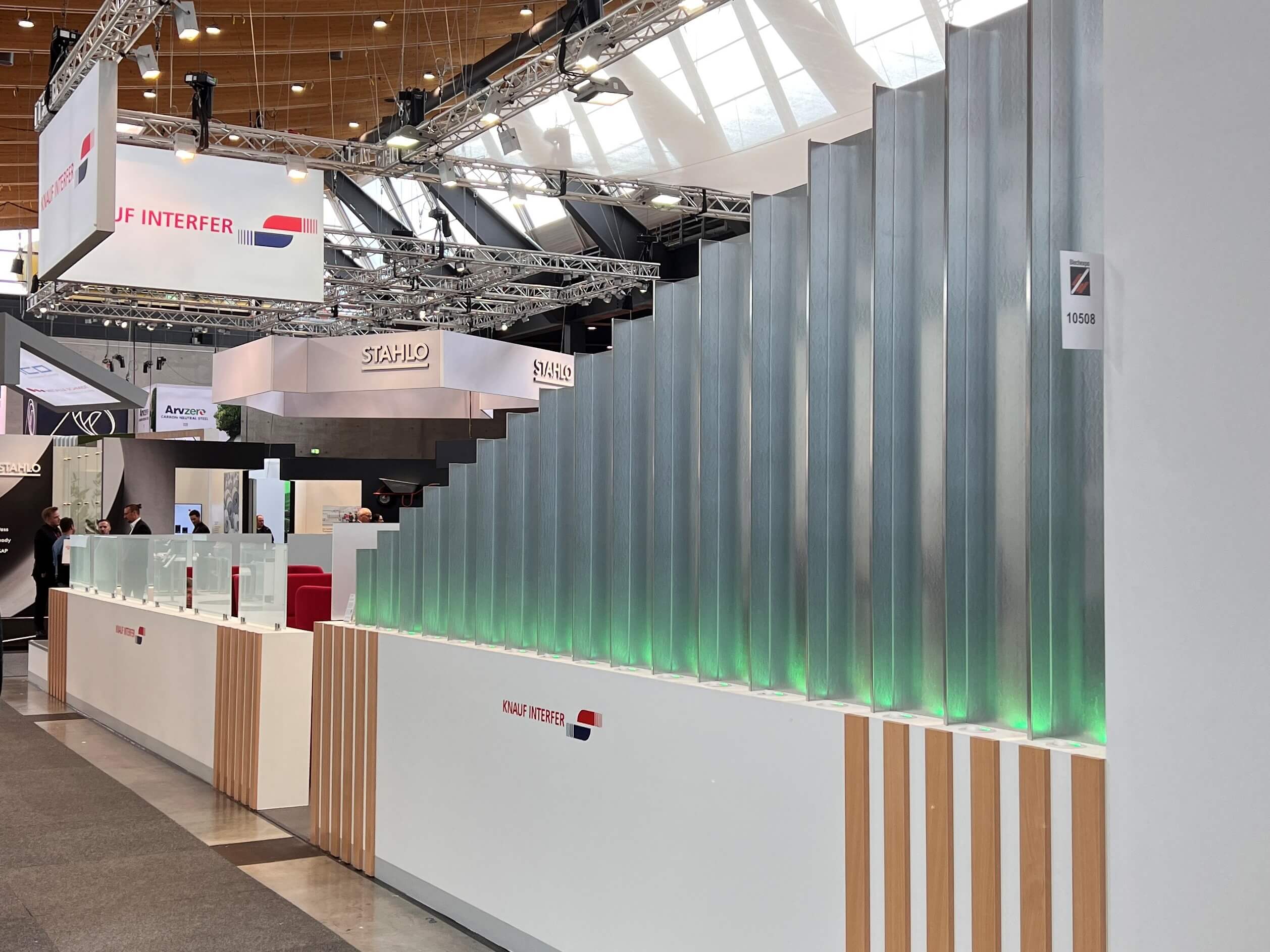
For this reason, SCHRAG, Knauf Interfer and thyssenkrupp Steel are already laying the foundations for a more sustainable product portfolio and are trialling the processing of bluemint® steel from thyssenkrupp across the entire process chain. SCHRAG will be presenting its first exhibit at the Knauf Interfer stand to coincide with Blechexpo 2023: SCHRAG purlins made fromCO2-reduced steel. This is not the first time that SCHRAG has set new standards. As market leader and trendsetter, the company was one of the first in the industry to use high-strength grades, for example, in order to realise larger spans and material savings in industrial construction projects. The same now applies in the area of environmentally friendly materials. The co-operation between thyssenkrupp Steel, Knauf Interfer and the SCHRAG Group is not only an economic one. It also emphasises the shared vision of the three companies to develop long-term sustainable business models and take a stand on socially relevant issues. "For us, this means setting an example of resource-conserving behaviour. Sustainable prosperity is based on responsible behaviour. We are fair, conserve resources, use renewable energy for our modern machines and strive to continuously improve our production processes," says Thomas Goswin. Torsten Gieseke, Head of Business Unit Steel/Managing Director of Knauf Interfer, adds: "As the Business Unit Steel, we take on the central role in the green transformation of accompanying our customers on the path toCO2-reduced products and demonstrating optimal solutions in line with the production possibilities of steel manufacturers: We now want to show that together we are 'green-steel-ready'."